Most people know Bank of America as one of the country's largest banks. Fewer know that Bank of America played a central role in creating the modern credit card we know today. In 1958, Bank of America launched BankAmericard, the first U.S. consumer card program with a revolving credit feature. That program eventually evolved into the payment network now known as Visa. To understand how a single issuer came to shape an entire industry, it helps to start more than a century ago, on a wooden plank in earthquake ravaged San Francisco.
From a Produce Cart to the Bank of Italy
Amadeo Peter Giannini was born in San Jose, California, in 1870, the son of Italian immigrants, and began his career in his family’s produce business. In 1904 he opened the Bank of Italy in San Francisco with a then radical premise: that working people and immigrants — customers many established banks overlooked — were just as creditworthy as the wealthy. It was a bet on ordinary borrowers that would define the institution for the next century.
That philosophy was tested almost immediately. When the 1906 earthquake and fire destroyed much of San Francisco, Giannini reportedly set up a desk made from a plank laid across two barrels and lent money to residents and business owners trying to rebuild — often on little more than a handshake. The bank's reputation for backing everyday customers in a crisis became part of its founding legend.
Gianni believed that working-class people were no less likely to pay their debts than the wealthy.
Branch Banking and the Birth of “Bank of America”
One of Amadeo Giannini's most significant innovations was pioneering branch banking in the United States. At the time when most American banks operated as single locations, Giannini expanded the Bank of Italy through a growing network of branches across California, making banking services more accessible and helping fuel the bank's rapid growth. After merging with Bank of America, Los Angeles in 1928, the institution adopted the Bank of America name in 1930 and continued expanding across California. By the mid-1940s, Bank of America ranked among the largest commercial banks in the world.
1958: The Card That Changed Everything
Charge cards already existed. Diners Club introduced a travel and entertainment card in 1950, but cardholders were generally required to pay their balances in full each month. In 1958, Bank of America introduced BankAmericard, the first U.S. consumer card program with a revolving credit feature. Instead of requiring full monthly repayment, BankAmericard allowed cardholders to carry a balance and repay it over time. That revolving credit model became the foundation of the modern consumer credit card.
Bank of America expanded BankAmericard through a licensing program beginning in 1966, allowing banks outside California to issue the card. As the licensing program expanded, BankAmericard evolved into an independent payment network. In 1976, the network adopted the Visa name, becoming the global payment network now known as Visa.
Mergers, Charlotte, and the Modern Era
The modern Bank of America is the result of decades of growth and mergers. One of the most significant milestones came in 1998, when Charlotte based NationsBank merged with BankAmerica. The combined company adopted the Bank of America name and established its headquarters in Charlotte, North Carolina, where it remains today. During the 2008-09 financial crisis, Bank of America acquired Countrywide Financial and Merril Lynch, ecpanding its consumer lending, mortgage, and wealth management businesses. Today, Bank of America operates across consumer banking, credit cards, wealth management, and investment banking while serving millions of consumers and businesses worldwide.
Bank of America's Card Business Today
More than six decades after introducing BankAmericard, Bank of America remains one of the largest credit card issuers in the United States. According to the company’s 2025 annual report, its consumer credit card business generated $377.8 billion in purchase volume during 2025, with average credit card balances of $103.0 billion and 2.53 million new credit card accounts opened during the year.
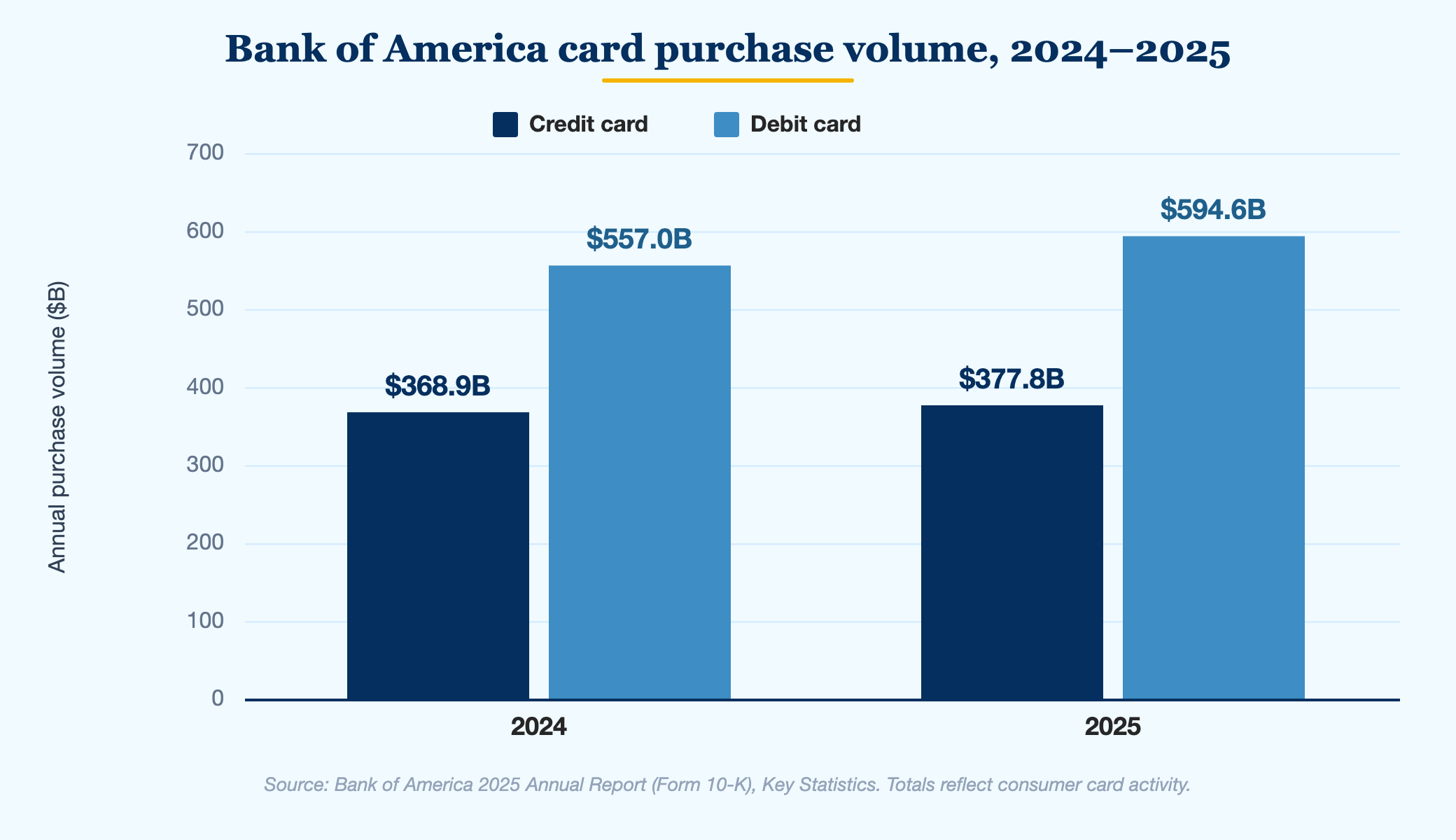
A snapshot of the institution today, drawn from its most recent annual report and disclosures:

Why This History Matters When You Choose a Card
Bank of America’s history helps explain its role in the evolution of modern consumer credit. From launching BankAmericard in 1958 to helping establish the payment network that became Visa, the company has played a significant role in the development of the U.S. credit card industry. Today, Bank of America offers credit cards across a range of categories, including cash back, travel rewards, student, secured, and premium rewards cards. Understanding the issuer's history provides useful context for how its credit card business has evolved over more than a century.
EXPLORE BANK OF AMERICA ON COMPARECREDIT
→ See Bank of America's current credit card lineup
→ Everyday cash-back and rewards programs
→ Travel and premium card programs
→ Cards for small businesses
Sources
Bank of America, 2025 Annual Report (Form 10-K), “Key Statistics” — credit/debit purchase volume, new accounts, financial centers, digital users. U.S. Securities and Exchange Commission (SEC.gov).
Bank of America Newsroom, “BofA AI and Digital Innovations Fuel 30 Billion Client Interactions” (March 2026) — Erica and digital engagement figures.
Office of the Comptroller of the Currency (OCC), “Bank of America: The Humble Beginnings of a Large Bank” — founding and 1906 earthquake history.
Encyclopaedia Britannica, “Bank of America” — BankAmericard (1958), Diners Club comparison, licensing and Visa renaming, corporate history.
EBSCO Research Starters, “Bank of America Corporation” — corporate profile, NationsBank merger, modern figures.


